
Overview
Liquid chromatography coupled with tandem mass spectrometry (LC-MS/MS) is an analytical technique that combines the separation of compounds by liquid chromatography (LC) with their detection and identification by mass spectrometry (MS/MS). This combination allows the analysis of different compounds in complex samples. It is particularly useful for the identification and quantification of bioactive compounds, as well as for the development of analytical methods for different types of samples.
How does LC-MS/MS work?
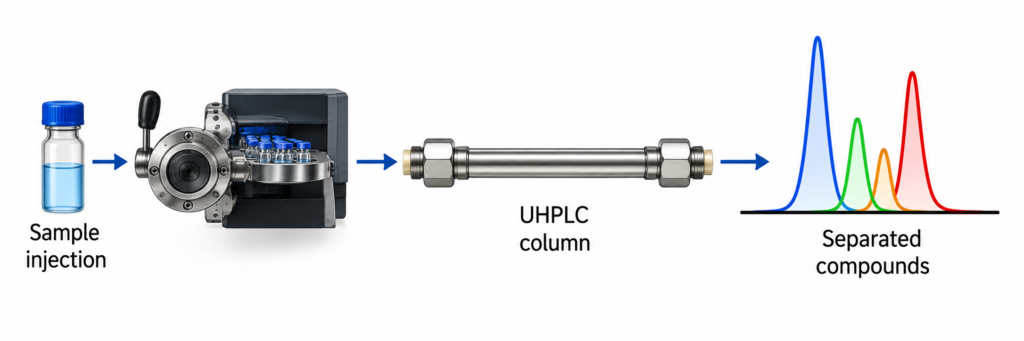
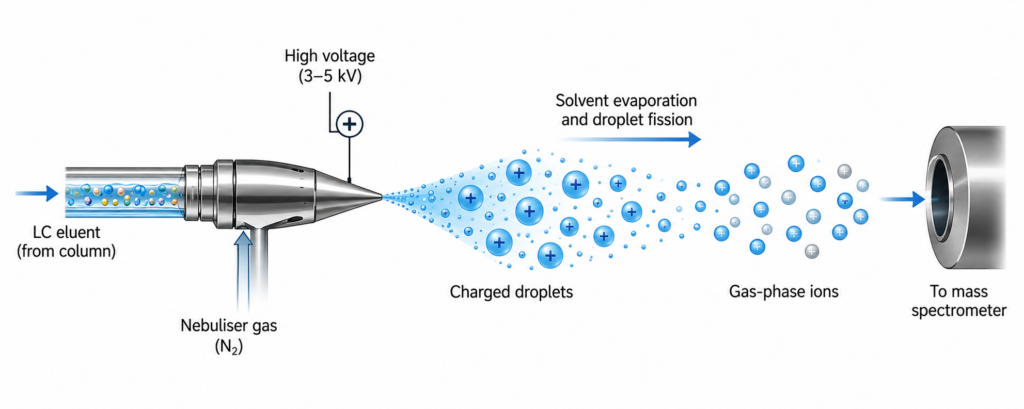
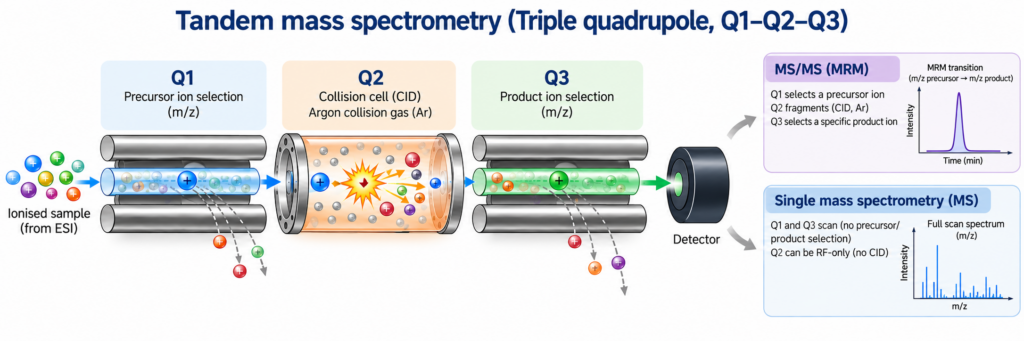
LC-MS/MS analysis is based on three main stages: chromatographic separation, ionisation and mass spectrometric analysis.
What is LC-MS/MS used for?
LC-MS/MS is used in a wide range of fields, including food science, pharmaceutical research, environmental analysis, biotechnology and the chemical industry. This is mainly due to its ability to separate, identify and quantify compounds, making it suitable for different purposes, from routine quality control to research and product development.
In the pharmaceutical industry, for example, it is used throughout drug development, as well as for the analysis of pharmaceutical products and the study of their stability. In food science, it can be applied to assess product quality and safety, characterise food products and develop analytical methods. It is also a useful tool in environmental studies, where it helps monitor chemical substances and investigate possible sources of contamination. In addition, its use in biotechnology and other industrial sectors has increased, particularly when the analysis of complex samples or the development of specific analytical procedures is required.
In research, LC-MS/MS is often used to identify and quantify compounds in complex samples. It can also be applied to compare different extraction procedures and assess how experimental conditions affect the compounds being analysed. Another advantage is that several target compounds can be monitored in a single analysis, which makes it possible to obtain more information from each sample and compare the results obtained under different conditions.
LC-MS/MS and the study of bioactive compounds
LC-MS/MS is also particularly useful in the study of bioactive compounds in food products, plant materials and agro-industrial by-products. Since these samples may contain a wide variety of compounds, their analysis requires techniques capable of separating the different components and determining their presence and concentration. In this context, LC-MS/MS can be used to characterise extracts, compare extraction conditions and evaluate the recovery of compounds of interest. The information obtained can help to better understand the chemical composition of these materials and identify suitable conditions for their further use.
Key advantages
The main advantages of LC-MS/MS include:
- High sensitivity, allowing the detection of compounds at low concentrations
- High selectivity through the combination of chromatographic separation and mass spectrometric detection
- Quantification of specific compounds using appropriate calibration methods
- Analysis of complex samples following suitable sample preparation
- Possibility of analysing different families of compounds by developing specific analytical methods
- Simultaneous monitoring of several target compounds within the same analytical run
Overall, LC-MS/MS represents a useful analytical tool for the characterisation of complex food matrices and the study of compounds with potential added value.